

A continuous query runs indefinitely over a stream of incoming data, producing results that update as new information arrives. This type of query stands apart from traditional approaches by maintaining state and handling data that never stops flowing. The table below outlines how a continuous query compares to a traditional query:
| Feature | Traditional Query | Continuous Query |
| Input Data | Finite, static dataset | Unbounded, dynamic data streams |
| Execution | Runs once and terminates | Runs perpetually until explicitly stopped |
| Output | Single, fixed result set | Continuously updating result set |
| State | Typically stateless | Often stateful (maintains past data) |
| Time Semantics | Implicit snapshot ('now') | Explicit event or processing time handling |
Continuous queries enable organizations to monitor sensor networks, financial transactions, or social media feeds in real time. They support stream processing by allowing each query to deliver up-to-date insights without manual intervention.
Key Takeaways
Continuous queries run nonstop on live data streams, updating results automatically as new data arrives, unlike traditional queries that run once on static data.
They provide fast, real-time insights by processing data incrementally and adapting to changes, making them ideal for monitoring and analytics in dynamic environments.
Choosing the right result emission method balances speed and completeness, helping users get timely updates that fit their needs.
Setting up continuous queries involves defining data sources, filters, and query logic carefully to ensure efficient and accurate processing.
Continuous queries power real-time applications across industries like finance, IoT, and manufacturing, enabling quick decisions and better system monitoring.
What Is a Continuous Query?
Core Concept
A continuous query represents a powerful approach for handling data that never stops arriving. Unlike traditional queries, which run once and return a static result, a continuous query operates over a stream of incoming data and keeps running until explicitly stopped. This ongoing process allows users to receive updated results automatically as new data flows in, eliminating the need to reissue the same query repeatedly.
The core concept of a continuous query centers on two main components:
The underlying cache that stores the data relevant to the query.
The query itself, which continuously applies logic to the cache, maintaining an up-to-date subset of results.
Together, these elements ensure that the system always reflects the latest state of the data. A continuous query maintains a real-time view, making it ideal for scenarios where information changes rapidly, such as financial markets or sensor networks.
Note: The idea of continuous queries first appeared in the early 1990s to address the need for monitoring data that evolves over time. Over the years, this concept has matured, moving from theoretical research to practical tools used in modern streaming databases.
Key Features
Continuous queries stand out from traditional database queries due to several important features:
Approximate Answers: Because data streams can be infinite or arrive at high rates, a continuous query often provides approximate rather than exact answers. This approach allows systems to deliver timely insights even when perfect accuracy is not possible.
Data-Driven and Incremental Processing: Continuous queries process data as it arrives, updating results incrementally. This contrasts with traditional queries, which access stored data and produce results on demand.
Run-Time Optimization: A continuous query adapts to changing data patterns and system conditions. It optimizes itself during execution, rather than relying on a single optimization step before running.
Persistent Monitoring: Continuous queries persist over time, updating their results whenever relevant data changes. They do not expire after producing a single result.
Efficient Updates: Instead of recalculating results from scratch at every moment, a continuous query updates only when necessary. Techniques such as defining safe regions help reduce unnecessary processing and communication.
Handling Dynamic Parameters: Continuous queries can monitor both static and dynamic queries, adjusting to changes in parameters or data sources over time.
These features make continuous queries essential for applications that require real-time analytics, monitoring, and rapid response to changing data. By maintaining an always-updated view, a continuous query supports decision-making in environments where speed and accuracy matter.
How Continuous Queries Work
Continuous Operation
Continuous queries operate by running perpetually over incoming data streams. They do not terminate after producing a single result. Instead, they update the query result as new data arrives, enabling real-time insights for users. This ongoing process relies on several mechanisms:
Continuous queries process dynamic data streams, updating results immediately when new information appears.
Time-based operations, such as window functions, segment the stream into intervals. Tumbling windows divide the data stream into fixed periods, while sliding windows create overlapping intervals for ongoing analysis.
Complex Event Processing (CEP) techniques allow the system to detect patterns and correlate events. These methods help derive meaningful insights from the stream.
The system maintains ongoing computations over unbounded streams, ensuring low latency and high throughput.
Advanced stream processing platforms, such as DeltaStream, provide fine-grained control over the lifecycle of a continuous query. Users can start, restart, or terminate queries explicitly. This flexibility supports the management of real-time data pipelines and continuous computation.
To maintain continuous operation, technical requirements must be met:
Optimize data processing with in-memory and parallel processing.
Implement robust error handling and recovery mechanisms.
Design resilient architectures using distributed processing and efficient topic partitioning.
Monitor streaming pipelines to detect bottlenecks and optimize performance.
Enforce security measures, including encryption and access control.
Enable scalability by dynamically adjusting resources.
Establish disaster recovery strategies for business continuity.
Apply expert recommendations, such as event sourcing and backpressure mechanisms.
Popular platforms like Apache Kafka, Amazon Kinesis, and Apache Flink support these requirements, ensuring that continuous queries deliver fast and accurate results.
Continuous queries must maintain fast and accurate data processing to avoid data loss and inaccuracies. They ensure data consistency and quality in real-time streams through validation and cleansing.
Dataflow and State
A continuous query begins with an initial startup phase. The system queries the source data once to load the initial state. After this bootstrapping, the query does not re-query the source data. Instead, it listens to streams of change events, such as inserts, updates, and deletes. These events represent low-level changes in the source data.
The system processes these events incrementally. Each event triggers an update to the query result, ensuring that the results remain accurate and up-to-date. The query subscribes to specific sources, describing the types of changes it wants to receive. This approach enables precise detection and reaction to data changes.
Indexes configured via storage profiles help maintain state. The system supports atomic change notifications and immediate updates. This design avoids inefficient polling and provides full visibility into query result changes at any time. The query result reflects the latest state, supporting real-time analytics and monitoring.
Continuous queries in Drasi use bootstrapping to establish initial state, then process streams of change events to update the query result continuously. This method ensures perpetual accuracy and immediate updates.
Result Emission
Continuous queries emit results using several strategies. The choice of emission method impacts latency and downstream processing. The table below summarizes the main methods:
| Emit Strategy | Behavior | Pros | Cons | Use Case / Latency Impact |
| Emit on Watermark / Window Close | Emit results only once when watermark passes window end, indicating completeness | Single, final, complete result per window | Higher latency due to waiting for watermark | Suitable for batch-like processing; higher latency but final completeness |
| Emit Immediately / Continuous Mode | Emit updated results every time new input affects the result | Lowest latency; always up-to-date results | High volume of intermediate updates | Real-time monitoring and alerting; lowest latency but intermediate partial results |
| Periodic Emit / Processing Time Trigger | Emit results at fixed time intervals regardless of event arrival or watermark | Predictable update frequency; bounds output rate | Latency depends on trigger interval; may not align with event-time windows | Dashboards needing regular updates; latency balanced with update frequency |
| Accumulating Mode | Emit all intermediate results as they accumulate | Shows incremental progress | Can produce many updates | Similar to continuous mode for windows; intermediate latency and updates |
| Accumulating & Retracting Mode | Emit retraction of previous result followed by new result to maintain downstream state | Enables correct downstream state maintenance | More complex downstream processing | Used in sinks for changelog streams; supports low-latency updates with accurate state replication |
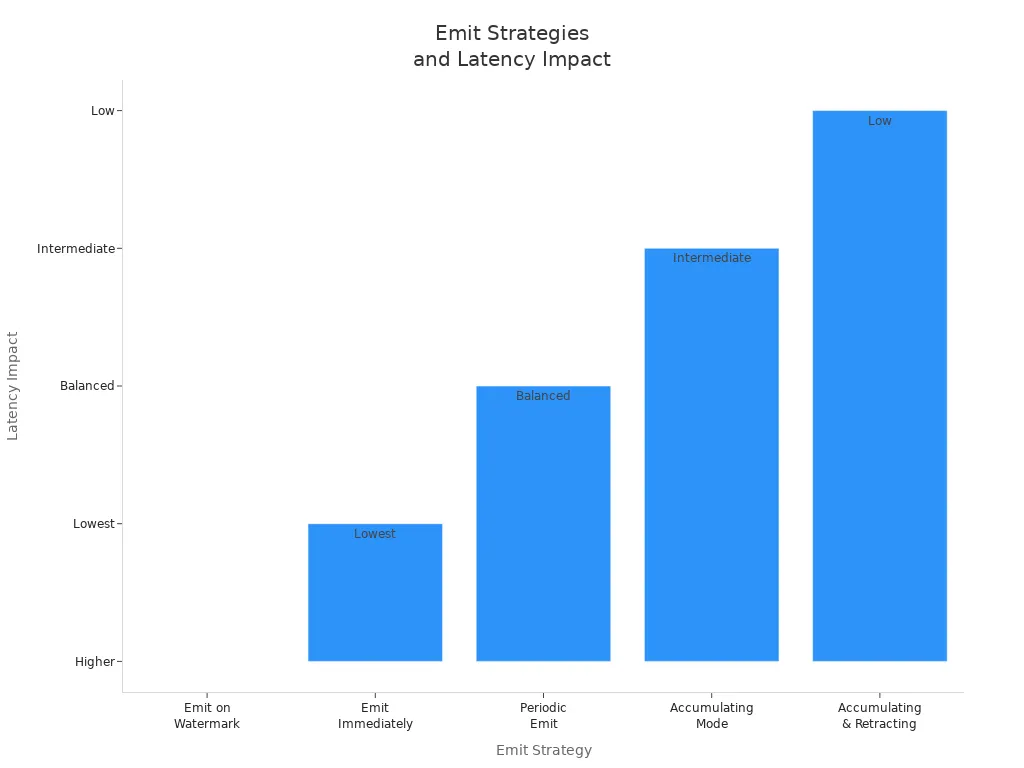
Emit strategies determine how quickly users receive updated results. Immediate emission provides the lowest latency, supporting real-time monitoring and alerting. Watermark-based emission waits for completeness, resulting in higher latency but final results. Periodic emission balances latency and update frequency, making it suitable for dashboards.
Continuous queries can emit accumulating results, showing incremental progress. Accumulating and retracting modes maintain downstream state accurately, supporting changelog streams and low-latency updates.
Tip: Selecting the right emit strategy depends on the application's requirements for latency, completeness, and update frequency.
Continuous Queries vs. Traditional Queries
Execution Differences
Continuous queries and traditional queries differ fundamentally in how they process and deliver results. Traditional queries operate on static data snapshots. They follow a clear sequence: parse, execute, and fetch. The system gathers results into a cursor, then iterates over them until completion. This approach produces a finite result set and ends after execution.
Continuous queries, in contrast, run perpetually on unbounded data streams. They process incoming data as it arrives, emitting results continuously to sinks such as message streams or persistent storage. This ongoing execution enables real-time applications to maintain up-to-date views. Continuous queries introduce constructs like time windowing, which allow the system to handle streaming data semantics. The execution mindset shifts from batch processing to ongoing, incremental updates. Instead of static results, users receive continuously updated snapshots that reflect the latest state of the data.
Note: Continuous queries enable organizations to materialize real-time views, supporting immediate insights and rapid response.
Use Cases
Continuous queries excel in scenarios that demand real-time analytics and monitoring. Common use cases include:
Downsampling and data retention: These queries automatically reduce data precision over time, saving storage while preserving essential trends.
Precalculating expensive queries: By pre-aggregating or downsampling data, continuous queries speed up response times and lower resource consumption.
Substituting for HAVING clauses: In systems lacking certain SQL features, continuous queries pre-aggregate data, enabling advanced filtering.
Substituting for nested functions: They calculate inner functions first, supporting complex analytics even when nesting is not available.
Real-time analytics: Businesses analyze customer behavior, market trends, and operational performance as data flows in.
Monitoring and alerting systems: Continuous queries support ongoing observation of system metrics, enabling real-time anomaly detection and automated alerts.
These use cases highlight the value of continuous queries in environments where data changes rapidly. They ensure analytics and monitoring remain current, relevant, and responsive, unlike traditional queries that provide only static results.
Setting Up a Continuous Query
Example Steps
Setting up a continuous query resource involves several clear steps. Many platforms, such as InfluxDB, use a structured approach to define and manage these resources. The following steps outline a typical process:
Identify the source data bucket that contains the information to monitor.
Define the time range for the data to process. This step ensures the continuous query resource focuses on relevant periods.
Apply filters to target specific data points or measurements within the source data.
Write the query logic using the platform’s query language, such as Flux for InfluxDB.
Configure the continuous query resource to run at defined intervals or in response to new data events.
Set up the destination for the results, such as another bucket or an external system.
Here is a simple example of a continuous query resource in InfluxDB using Flux:
from(bucket: "sensor_data")
  |> range(start: -1h)
  |> filter(fn: (r) => r._measurement == "temperature")
  |> aggregateWindow(every: 5m, fn: mean)
  |> to(bucket: "downsampled_data")
This query monitors the "sensor_data" bucket, processes the last hour of data, filters for temperature readings, and calculates the mean every five minutes. The results move to the "downsampled_data" bucket.
Configuration Tips
A well-configured continuous query resource ensures reliable and efficient data processing. Consider these best practices:
Use precise filters to reduce unnecessary processing and focus on critical source data.
Schedule the continuous query resource at intervals that match business needs. Too frequent execution may overload the system, while infrequent runs can delay insights.
Monitor the performance of each continuous query resource. Adjust window sizes and aggregation functions to balance accuracy and speed.
Test the query logic with sample data before deploying it in production.
Document each continuous query resource, including its purpose, logic, and expected output.
Tip: Avoid common pitfalls such as missing indexes on source data or using overly broad filters. These issues can slow down the continuous query resource and impact overall system performance.
Benefits and Applications
Real-Time Analytics
Stream processing platforms have transformed how organizations analyze data. By leveraging stream processing, companies can process a data stream as it arrives, producing query results with minimal delay. Statistical studies show that continuous aggregates in systems like TimescaleDB reduce query execution times from minutes or hours to milliseconds. This improvement comes from pre-aggregating data and separating retention policies from raw data. Real-time dashboards now deliver insights almost instantly, with query result changes visible as soon as new data enters the stream. These advances enable businesses to make decisions quickly and reduce computational load by up to 90% compared to traditional methods.
Note: Efficient stream processing ensures that query result changes reflect the most current state, supporting rapid business responses.
Monitoring and Alerts
Stream processing supports continuous monitoring by collecting and analyzing data from logs, metrics, and traces. This approach allows immediate detection of anomalies or security threats. Tools such as Prometheus use stream processing to process time-series data and trigger automated alerts based on predefined rules. Dashboards like Grafana and Kibana visualize query results in real time, helping teams monitor alert histories and system health. Time-series databases maintain up-to-date aggregate views, ensuring that query result changes are always current. This integration of stream processing, databases, and visualization tools forms the backbone of modern monitoring and alerting systems.
Industry Uses
Many industries rely on stream processing for mission-critical applications. In financial services and IoT, organizations use real-time auditing to track transactions and ensure transparency. Fraud detection systems analyze a data stream from IoT devices to identify suspicious activity. ATM management platforms monitor status and performance, while wealth management tools provide real-time portfolio insights. In enterprise IoT, smart manufacturing connects equipment with sensors that monitor pressure, vibration, and temperature. This setup enables predictive maintenance and energy optimization. AI-powered chatbots in banking, such as those used by Wells Fargo and Morgan Stanley, deliver real-time assistance and insights by processing a continuous stream of customer interactions. These examples highlight how stream processing delivers timely query results and supports immediate query result changes across diverse sectors.
Tip: Organizations should optimize stream processing pipelines to ensure that query results remain accurate and up to date, especially as data stream volumes grow.
The table below summarizes how a continuous query operates, from detecting changes in source data to distributing precise notifications:
| Aspect | Description |
| Definition | Runs continuously, maintaining up-to-date results by detecting changes in source data and distributing notifications. |
| Query Language | Supports Cypher and GQL for defining logic. |
| Storage Profile | Controls caching and indexing. |
| Sources | Includes subscriptions, joins, and middleware. |
Real-time data processing enables organizations to act instantly, improving decision-making and infrastructure resilience. Those interested in implementation can explore resources like Red Hat Data Grid documentation or Nexla’s integration tools for practical guidance.
FAQ
What is the main advantage of using continuous queries?
Continuous queries provide real-time insights by updating results as new data arrives. This approach allows organizations to react quickly to changes and make informed decisions without manual intervention.
Can continuous queries handle large volumes of data?
Yes. Modern stream processing platforms scale horizontally to manage high data volumes. They use distributed computing and in-memory processing to maintain performance and reliability.
How do continuous queries differ from scheduled batch jobs?
Continuous queries run perpetually and update results instantly. Scheduled batch jobs process data at fixed intervals and may introduce delays. Continuous queries suit applications that require immediate feedback.
Are continuous queries difficult to maintain?
Most platforms offer user-friendly interfaces and automation tools. Proper configuration and monitoring help teams maintain continuous queries efficiently. Regular reviews ensure optimal performance.
Which industries benefit most from continuous queries?
Industries such as finance, IoT, manufacturing, and telecommunications use continuous queries for monitoring, analytics, and rapid response. These sectors rely on up-to-date information to maintain operations and improve outcomes.


